
 By Nikhil Bavaskar, Content Marketing Executive, Accelirate Inc.
LinkedIn: Nikhil Bavaskar
LinkedIn: Accelirate Inc.
Healthcare organizations have spent the last few years testing where artificial intelligence can help. Many have moved beyond pilot projects. Today, AI supports clinical documentation, patient communication, prior authorization, scheduling, and revenue cycle work. The focus is now changing. The challenge is no longer getting AI into production. The challenge is making sure it works safely after deployment.
Many healthcare leaders are finding that deploying AI is easier than managing it. Once AI starts influencing clinical, financial, and administrative workflows, teams need to know how decisions are made and what happens when something goes wrong. That’s where AI Operations comes in. Strong governance, visibility and control enable organizations to deploy AI with confidence and mitigate risk easily.
Why Trust Matters in Healthcare AI
Trust has always been an important part of healthcare. Patients trust providers with personal information. Clinicians trust the systems that support care decisions. Now healthcare organizations must extend that trust to AI.
Unlike traditional software, AI can make recommendations, find patterns, and influence decisions across many workflows. That creates value, but it also creates risk. Leaders need answers to simple questions.
- Which decisions can AI make autonomously?
- When is human review required?
- How should risks be assessed?
Think of an AI tool that recommends medical codes. If those recommendations are wrong, claims could be delayed and staff could spend hours fixing errors. The problem is not that AI makes mistakes. Every technology has limits. The real question is whether an organization can identify those mistakes quickly enough and respond before they do bigger damage.
The same challenge exists in patient-facing workflows. A recent healthcare assistant case study achieved 90% coverage in automated appointment scheduling and reduced manual coordination efforts significantly. Yet the success of the initiative depended not only on AI performance but also on clear oversight, visibility into interactions, and well-defined boundaries for human intervention.
Governance: Creating Accountability from Start
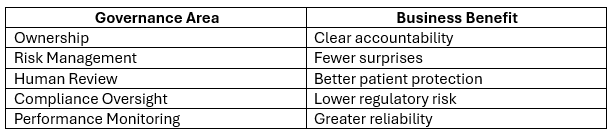
Good governance gives healthcare organizations a clear way to manage AI Operations. It defines ownership, sets responsibilities, and creates a process for reviewing risk. Without governance, AI projects often struggle as they grow.
Most healthcare organizations have rules for cybersecurity, privacy and quality of care. AI should be no different. Every AI system needs a clear owner who reviews performance and takes action when results don’t meet expectations.
Governance assists organizations in identifying where human review is still necessary. Certain tasks can be automated without concern, whereas others necessitate the watchful eye of clinicians or business leaders. Defining these boundaries well from the beginning aids teams in gaining confidence in deploying AI.
Visibility: Understanding What Happens After Deployment
Many AI projects receive a lot of attention before launch and very little afterward. That creates blind spots. Healthcare organizations cannot manage systems they cannot see.
Visibility means knowing how AI is working in the real world. Leaders need to be able to dig into any strange behavior, look at the recommendations and see how AI decisions impact other processes. This is especially true when AI touches patient records, billing systems or operational workflow.
Real-world deployments are already showing why this matters. At Cleveland Clinic, an AI-powered documentation assistant was adopted by thousands of clinicians and cut down on administrative work. While notes still need physician review before they’re added to patient records, it shows the value of visibility and human oversight even when AI offers big gains in efficiency. Continuous visibility enables organizations to detect problems early, and build trust over time.
Visibility also enables adoption. Clinicians and operational teams are more likely to use AI when they understand how recommendations are made and where human judgment is still a factor.
Control: Keep Humans in the Loop
AI in healthcare is not about replacing humans. It’s about helping them do their jobs better. That’s why good control of AI is so important.
As AI tools get smarter, they start to take on more of daily workflows. They can see information, identify trends and suggest. But even then, organizations still need clear approval processes, escalation paths, and easy ways for folks to step in when they need to.
This is especially as Agentic automation begin operating across departments. A recommendation from one system can influence decision making in another. Without the correct controls it can be difficult to understand how actions are linked across the organization. Human oversight ensures that speed and efficiency do not have to be compromised for accountability.
Looking Beyond Deployment
The healthcare organizations seeing the greatest value from AI are treating it as an operational capability rather than a technology project. They are investing not only in deployment but also in the processes needed to govern, monitor, and manage these systems over time.
Healthcare leaders will continue exploring new uses for AI Agents. The organizations that succeed will not be the ones that deploy the most tools. They will be the ones that build trust around those tools. Strong AI Operations, supported by governance, visibility, and control, will help healthcare organizations scale AI safely and responsibly.