
 By Ubaid Pisuwala, Co-Founder & CTO, Peerbits
LinkedIn: Ubaid Pisuwala
LinkedIn: Peerbits
Revenue cycle management has always been the quiet engine behind a healthcare organization’s financial health. But for too long, that engine has run on outdated fuel manual processes, human error, and reactive denial management that costs U.S. providers billions of dollars each year.
Artificial intelligence is fundamentally changing that equation. Today, AI powered medical coding systems aren’t just automating tedious tasks they’re transforming how providers capture revenue, reduce claim denials, and ensure compliance at scale. For healthcare CFOs, revenue cycle directors, and health IT leaders, understanding this shift isn’t optional. It’s strategic.
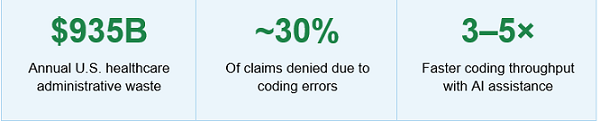
The Hidden Cost of Manual Medical Coding
Medical coding is deceptively complex. A single patient encounter may involve dozens of diagnosis codes (ICD-10-CM), procedure codes (CPT/HCPCS), and modifiers each requiring a coder to interpret clinical documentation, apply payer-specific rules, and stay current with regulatory changes that happen multiple times per year.
The consequences of getting it wrong are immediate and expensive:
- Undercoding leaves legitimate revenue on the table, often permanently.
- Upcoding triggers audits, penalties, and reputational damage.
- Miscoded claims create denial backlogs that strain billing staff and delay cash flow by weeks.
- Coder burnout and attrition introduce additional inconsistency into an already fragile process.
For large health systems processing tens of thousands of claims monthly, even a 2–3% coding error rate translates to millions of dollars in avoidable write-offs and rework costs.
How AI Is Reengineering the Coding Workflow
AI-powered medical coding doesn’t replace clinical judgment it augments it. Here’s how modern AI coding platforms are changing the workflow across the revenue cycle:
- NLP-Driven Documentation Analysis
Natural Language Processing engines parse clinical notes, operative reports, discharge summaries, and pathology results in real time extracting diagnosis indicators and procedure details that human coders might miss or deprioritize under volume pressure. - Automated Code Suggestion and Ranking
AI models trained on millions of historical encounters suggest the most appropriate ICD-10, CPT, and DRG codes ranked by confidence, with supporting documentation references. Coders review and approve rather than build from scratch. - Real-Time Compliance Guardrails
Built-in rule engines check code combinations against payer edits, CCI edits, LCD/NCD policies, and facility-specific fee schedules before a claim is ever submitted catching denials at the source. - Denial Prediction and Pre-Authorization Intelligence
Predictive models analyze claim characteristics against historical denial patterns to flag high-risk claims before submission, prompting proactive documentation correction or prior authorization requests. - Continuous Model Learning
Each adjudicated claim paid, denied, or appealed feeds back into the AI model, improving accuracy over time and adapting to payer behavior changes without manual rule updates.
Traditional RCM vs AI-Augmented RCM
Traditional RCM
- Coders manually review each note
- Errors discovered post-submission
- Static payer rule updates (quarterly)
- Denial management is reactive
- Throughput limited by headcount
- Inconsistency across coders/shifts
- High coder turnover and training costs
AI-Augmented RCM
- AI extracts codes from documentation
- Compliance checks pre-submission
- Continuous rule learning and updates
- Proactive denial prevention
- Volume scales without headcount
- Standardized accuracy across all claims
- Human coders focus on complex cases
Measurable Impact on Revenue and Operations
Health systems and physician groups that have deployed AI medical coding solutions report meaningful, measurable outcomes not just efficiency gains, but direct revenue impact:
- First-pass resolution rates improving from 60–70% to 90%+ as AI reduces coding errors before submission.
- Denial rates dropping 40–60% for AI-coded claims versus manually coded claims in comparable studies.
- Coder productivity doubling or tripling, enabling the same team to handle volume spikes without emergency hiring.
- Days in A/R reduced by an average of 4–7 days, directly improving cash flow and operating liquidity.
- Audit readiness improved as AI systems maintain detailed audit trails linking every code to its supporting documentation.
For a mid-size health system processing 50,000 claims per month, a 2-point improvement in first-pass resolution can represent $1–3M in annual recovered revenue with ROI typically achieved within 12–18 months of deployment.
Key Considerations for Healthcare Organizations
EHR and PM System Integration
AI coding tools must integrate deeply with existing Electronic Health Record and Practice Management systems. FHIR-compliant APIs have simplified this significantly, but organizations should evaluate how tightly a vendor’s solution connects with their specific EHR stack particularly for specialty-specific documentation patterns.
Change Management and Coder Adoption
The biggest implementation risk isn’t technical it’s cultural. Experienced coders may view AI as a threat rather than a tool. Successful deployments frame AI as a productivity multiplier that elevates coders into quality reviewers and exception handlers, rather than high-volume data entry roles.
Model Transparency and Auditability
In a compliance-heavy environment, black-box AI is unacceptable. Healthcare organizations should demand explainable AI systems that surface the specific documentation evidence behind every code suggestion enabling rapid audit response and ongoing coder education.
Specialty-Specific Training Data
A general AI model trained primarily on primary care encounters will underperform on orthopedic surgery or interventional cardiology claims. Verify that vendor models include specialty-specific training data relevant to your service lines.
The Road Ahead: From Automation to Intelligent RCM
AI medical coding is an early chapter in a larger transformation. The next generation of RCM technology is moving toward fully integrated intelligence where clinical documentation, coding, authorization, claims submission, and denial management are all connected in a continuous, learning feedback loop.
Emerging capabilities on the near-term horizon include:
- Ambient clinical documentation that generates coding-ready notes during the patient encounter, reducing documentation burden on clinicians.
- AI-driven contract modeling that predicts expected reimbursement against payer contracts and flags underpayment patterns automatically.
- Cross-system analytics that identify systemic documentation gaps affecting revenue across entire service lines, not just individual claims.
- Generative AI-assisted appeals that draft denial appeal letters from clinical documentation with minimal human authoring effort.
Organizations that invest in scalable AI RCM infrastructure today will be positioned to adopt these capabilities incrementally while competitors still working through denial backlogs manually will face an ever-widening performance gap.