
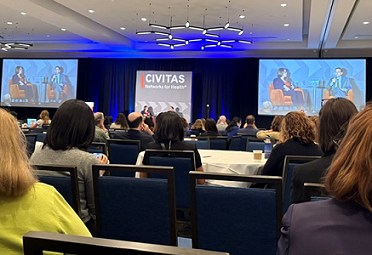
 As the Center for Medicare and Medicaid Innovation (CMMI) looks toward the next generation of value-based care, new technology will need to do more than improve how healthcare is delivered. It will increasingly need to demonstrate that it can improve outcomes without adding more cost to the system.
Abe Sutton, director of CMMI and deputy administrator at the Centers for Medicare & Medicaid Services, made that point during a keynote fireside chat at the Civitas Networks for Health 2026 Annual Conference with Theresa Dreyer, CEO of the Health Care Transformation Task Force.
Sutton pointed to electronic medical records as a cautionary example. He asked the audience whether the move to EHRs had taken costs out of healthcare. No hands went up.
“When we face new technological advancements, oftentimes they result in more cost when it comes to the healthcare system,” Sutton said.
CMMI wants future models to create a different dynamic. Sutton said the Innovation Center will continue focusing on pharmaceuticals, technology and healthcare delivery, with payment structures that encourage organizations to improve outcomes in cost-efficient ways.
Real-Time Data Will Matter
That evolution will also require better information about patients.
Discussing how organizations can prepare for CMMI’s Long-term Enhanced ACO Design (LEAD) Model, Sutton emphasized understanding attributed populations, identifying opportunities for intervention and determining which patients may benefit from technology-enabled outreach versus more intensive human support.
Organizations also need better information on patients in real time and the operational capabilities to act on it. Monthly data alone may not be sufficient. Sutton pointed to the need for more timely data sources, data governance and workflows that allow information coming from multiple organizations to be presented consistently and used by care teams.
CMMI Explores AI-Driven Risk Adjustment
CMMI is also exploring whether artificial intelligence could change how patient risk is determined.
Sutton discussed an approach that could use claims and potentially clinical information to infer patient conditions rather than relying exclusively on traditional coding.
The agency intends to move cautiously. Sutton described a “shadow” approach in which information could first be reported to model participants without immediately affecting payment, giving CMMI an opportunity to collect feedback and refine the methodology.
The challenge will be ensuring inferred risk accurately reflects patients’ clinical conditions without introducing new opportunities for gaming or incentives for unnecessary care.
Paying for Outcomes
The same outcomes-first philosophy is influencing CMMI’s approach to wearables and patient-generated health data.
For Sutton, simply giving patients access to more technology is not enough. The more important questions are whether the technology engages patients and whether that engagement changes behavior in ways connected to meaningful clinical outcomes.
From a payment perspective, Sutton said CMS does not necessarily need to determine precisely which information a technology should generate or how it should be presented.
“All I need to do is pay the outcome,” he said.
Across the discussion, Sutton’s message was consistent: Innovation remains central to CMMI’s strategy, but adoption alone is no longer the measure of success.
The next generation of value-based care will increasingly depend on whether technology, data and new care models can translate innovation into better outcomes at a sustainable cost.