
 By Andy Dé, Chief Marketing Officer, Lightbeam Health Solutions
LinkedIn: Andy Dé
LinkedIn: Lightbeam Health Solutions
Despite the hype and heavy investment, most organizations are discovering that generative AI is far harder to operationalize than imagined. MIT’s report, The Gen AI Divide: State of AI in Business 2025, reveals that 95% of Gen AI projects fail to reach meaningful production. That’s a staggering figure and means only 1 in 20 projects ever succeed. It’s time to face a harsh truth about Gen AI: Billions in capital and countless hours have yielded limited enterprise impact.
The problem isn’t vision; it’s execution. Generative AI still suffers from fundamental limitations, including:
- Hallucinations
- AI Bias
- Non-Determinism
- Security Issues and AI manipulation/hacks
- Constrained use cases and applications
In their haste to keep up, many organizations overlook these limitations, treating GenAI as a silver bullet rather than a system that demands disciplined integration, governance, and workflow design. Early wins with Ambient Clinical Intelligence (ACI) or Ambient Listening reveal both the potential of AI in healthcare and the significant operational transformation still ahead.
Today, we’re seeing a new chapter unfold with Agentic AI. As a quick definition, Agentic AI is the convergence of autonomous agents and adaptive operating systems. Unlike traditional modalities of AI, Agentic AI can plan, act, and collaborate to complete complex business and clinical workflows with minimal, as needed human intervention.
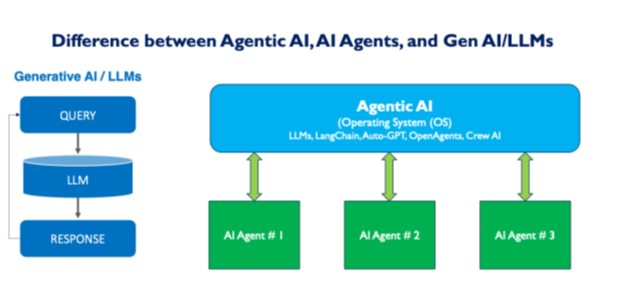
Figure 1: Difference between Gen AI/ LLMs, Agentic AI and AI Agents.
For executives, the imperative is shifting from experimenting with AI to engineering intelligent automation at scale. Given the extremely rapid pace of innovation, many CXOs are grappling with how to turn AI ambition into a coherent, value-driven and executable roadmap. The challenge has moved beyond whether to adopt AI; it’s how to do so with discipline, governance, and measurable value.
To address this need, I’ve developed a “Five-Stage Agentic AI Innovation and Adoption Lifecycle.” This framework is designed to guide organizations through the evolution of business, operational, and clinical process automation in population health management and beyond. While rooted in healthcare, this lifecycle can be extended across virtually any industry, including life sciences, consumer packaged goods, manufacturing, logistics, and retail.
The model illustrates two critical dimensions. The X-axis articulates the level of human intervention needed with Agentic AI automation while the Y-axis articulates the anticipated value, ROI, and payback from Agentic AI investments for healthcare and life sciences organizations. Together, these axes define a roadmap for scaling AI from isolated pilots to enterprise-wide transformation. Let’s dive into each section of this lifecycle.
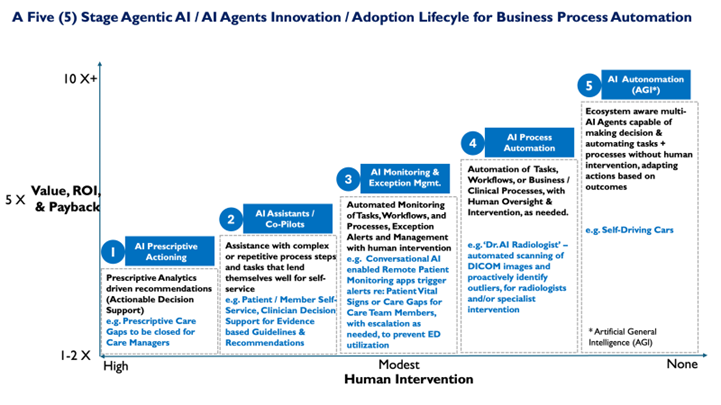
Figure 2: A five stage Agentic AI/AI Agent Innovation/ Adoption Lifecycle for Business and Clinical Process Automation for Population Health Management.
Stage 1- AI Prescriptive Actioning / Decision Support
AI Prescriptive Actioning, or actionable decision support, enables a significant step forward from traditional descriptive and predictive analytics. Rather than just explaining what happened or forecasting what might occur, prescriptive analytics deliver specific, actionable recommendations that guide decision-making at the point-of-care. A compelling example is the use of AI-driven insights to identify and close care gaps for high-risk or rising-risk patients, empowering care managers and clinical teams to take timely, evidence-based action. By embedding actionable decision support directly into workflows, organizations can move from insight to impact in real time.
Stage 2 – AI Assistants / Co-Pilots
AI Assistants / Co-Pilots represent the next step in augmenting human performance by supporting complex or repetitive processes across the enterprise. These agents enable self-service and guided workflows for executives, physicians, nurses, and even patients. Examples include Conversational AI Agents that empower care team members, patients and members to manage appointments or referrals, ambient listening tools that integrate with clinical workflows, and clinician decision support to surface evidence-based guidelines and recommendations at the point-of-care. Together, these solutions help to lower fatigue and administrative burden while driving measurable impact on productivity, consistency, and patient satisfaction.
Stage 3 – AI Monitoring and Exception Management
In this stage, Agentic AI assumes a supervisory role, continuously monitoring business, clinical, and operational workflows to detect anomalies and trigger timely interventions. These agents proactively identify exceptions, recommend corrective actions, and escalate issues based on criticality. In healthcare, for instance, Conversational AI-enabled Remote Patient Monitoring (RPM) apps can analyze patient vitals such as blood pressure, oxygen saturation, and glucose levels and alert care teams to potential risks and initiate responses that help close care gaps and prevent avoidable emergency visits.
Stage 4 – AI Process Automation
In this stage, Agentic AI evolves from decision support to active execution, involving partial or complete automation of tasks, workflows, or business / clinical processes with selective human oversight. This can dramatically improve speed, accuracy, and scalability. Perhaps the most compelling real-world example in healthcare is a ‘Dr. AI Radiologist’ Agent. It can automatically scan thousands of DICOM images (X-Rays, MRIs, or CT Scans) within minutes, document findings, and escalate high-risk cases such as an acute event like a heart attack (myocardial infarction) or a stroke to a radiologist before routing to the appropriate specialist. The result is a powerful combination of efficiency, precision, and life-saving intervention.
Stage 5 – AI Autonomation or Autonomous AI / Artificial General Intelligence (AGI)
At the pinnacle of this Agentic AI lifecycle is Autonomous AI, or AI Autonomation. This refers to AI systems capable of performing tasks and making decisions independently, without constant human intervention, by understanding their environment and adapting their actions based on the outcomes. This represents the frontier of Artificial General Intelligence (AGI), where machines can perceive, reason, and act with human-like cognition across diverse contexts. A familiar example of Autonomic AI is the ‘Self-Driving / Driverless Car’ that can drive its passengers from point A to point B leveraging machine vision and AI intelligence.
In healthcare, this level of autonomy remains aspirational at best. The high stakes of patient safety, the necessity for clinical oversight, and the ethical imperative for accountability demand continuous human governance. For now, Autonomous AI in a healthcare context is a daunting and distant horizon.
Conclusion:
As we think about the future of AI in the workplace, it’s important to consider the goal. Why are we building these systems? When thoughtfully designed and responsibly deployed, AI amplifies our humanity. The goal is not to replace it. By automating the administrative noise that consumes so much of clinicians’ time, AI gives back the bandwidth to focus on empathy, connection, and critical thinking. By turning data into understanding and processes into purpose, we’re enabled to do more of what only humans can do: listen, heal, and lead with compassion.
The path forward is not about replacing people with machines, but about designing systems that elevate human capability, empathy, and impact. As odd as this might sound, Agentic AI can help us create a more human healthcare experience. To do that, organizations need a solid framework to guide their path.
By adopting the Five-Stage Agentic AI Innovation and Adoption Lifecycle, healthcare organizations can align strategy, governance, and intelligent automation to reduce fatigue, improve care coordination, and elevate clinical, operational, financial, and experiential performance.
Empowering your organization through intelligent automation isn’t an innovation strategy; it’s honestly a moral imperative for the future of healthcare. Leaders who act now will define the next era of care delivery, allowing a measurable, human-centered experience for all.